Yes, you can take a Rorschach-style inkblot test online, and it’s a lot of fun. This one shows you nine original inkblots and asks one thing: what do you see first? Your answers point to your seeing style. But to be clear, this is not the real Rorschach test. The real one uses ten official cards and a trained psychologist. Below, you’ll find how the real test works, where it came from, and what your answers here can tell you.
The short version
- This is a fun inkblot test inspired by the Rorschach, with original blots. It’s just for fun.
- The real Rorschach uses ten official cards and is scored by trained psychologists.
- Hermann Rorschach published the test in his 1921 book Psychodiagnostik.
- Animals are the most common thing people see in the real cards.
In this guide
What is the Rorschach inkblot test?
The Rorschach test is a set of ten inkblots. A psychologist shows them one by one and asks, “What might this be?” There are no right answers. What matters is what you see, which part of the blot you use, and what made it look that way to you.
Each blot is mirror-image, left to right. Five of the official cards are black and grey, two add red, and three are full of color. Psychologists still use the test today as one tool among many, not as a test you pass or fail.
Who made the inkblot test, and when?
Swiss psychiatrist Hermann Rorschach created the test. He published it in 1921 in a book called Psychodiagnostik. Sadly, he died the next year, in 1922, before the test became famous.
Inkblots were already a game long before that. As a boy, Rorschach loved a game called Klecksography: you drop ink on paper, fold it, open it, and make up stories about the shape. His school friends even called him Klecks, the German word for inkblot.
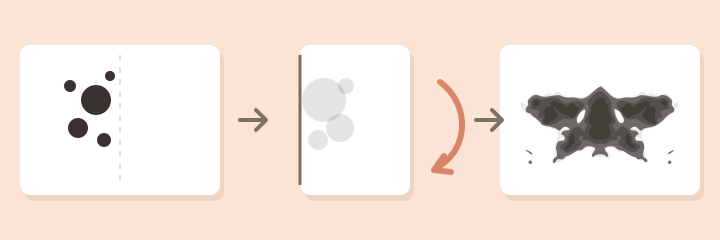
You can make your own the same way. Try it with kids or friends at the kitchen table, then compare what everyone sees. It’s a great way to find out how differently people look at the same thing.
How does a real Rorschach test work?
In a real test, the cards are always shown in the same order. First you say what you see. Then, in a second step, you explain which part of the blot gave you each answer and why.
The psychologist then codes your answers. Three things matter most:
- Where you looked.Did you use the whole blot, a common part of it, a small unusual part, or the white space around it?
- What made it look that way.The shape, the color, the shading, or a sense of movement, like “two people dancing.”
- What you saw.People, animals, objects, nature, and so on. Some answers are very common for a card, and some are rare.
Over the years, people scored the test in different ways. Psychologist John Exner pulled five rival methods into one, called the Comprehensive System. A newer system, R-PAS (the Rorschach Performance Assessment System), came out in 2011. It was made by members of Exner’s research group to fix problems with the older norms.
Reading the results takes a lot of training and experience. Experts have argued about what the test can really measure for decades. The debate got so heated that some call it the “validity wars.” So treat any online version, including this one, as play.
Is this a real Rorschach test online?
No, and that’s on purpose. This is a free, Rorschach-style inkblot test. The nine blots here are new ones, drawn just for this page. They are not the official cards. No online quiz can do what a trained psychologist does in a real session.
What this test does is simpler. Each blot gives you five choices, one for each seeing style. Every style gets the same number of chances, so your result shows which kind of answer you picked most. It’s a mirror for fun, not a measure of your mind.
If you’re searching for a Rorschach test online free of charge because something is really bothering you, a quiz isn’t the right tool. Talking it through with someone you trust, or a therapist, will help far more.
What do the five seeing styles mean?
- 👥 People Watcher.You see people and what they’re doing. You tend to read moods fast and care about how others feel.
- 🦋 Nature Lover.You see animals and living things. Animals are the most common answers on the real cards, so this style is very normal.
- 🔍 Detail Spotter.You find the small parts first: a dot, a tip, a gap. You notice what others miss.
- 🌕 Big-Picture Seer.You take in the whole blot and name it in one go. You sum things up fast.
- 🎨 Mood Reader.You react to color, texture and mood: smoke, fur, fire, confetti. You feel things before you name them.
Most people are a mix. Look at your second-highest bar too. It often fits you just as well.
How to have fun with your inkblot result
Send the test to a friend or your partner, then compare answers blot by blot. You’ll be amazed how two people can look at the same splash of ink and see a moose and a pair of dancers.
It’s also a gentle way into a real chat. “Why did you see two people pulling on a rope?” can lead to stories you’ve never heard. If a picture brought up a feeling you want to talk through, Iris is there in iMessage any time.
Sometimes it helps to say the messy, unfiltered version out loud to someone who won’t judge it. That’s Iris — text her like you’d text a close friend, and she’ll help you untangle it. She remembers the thread, so next time you can pick up right where you left off.
Frequently asked questions
What is the most common answer on the Rorschach test?
Animals. In the real test, animal answers are the single most common kind, making up about a quarter to half of all answers. On the first official card, “bat” is a popular answer. So if you saw lots of animals here, you’re in very good company.
Can I take the real Rorschach test online?
Not really. The real test uses ten official cards and needs a trained psychologist to give it and score it. Online inkblot tests like this one use new blots and are made for fun and self-reflection only.
Can you fail a Rorschach test?
No. There are no right or wrong answers. In a real test, the psychologist looks at patterns across all your answers, not at whether you “got it right.” In this test, every answer simply points to a seeing style.
Who invented the inkblot test?
Swiss psychiatrist Hermann Rorschach. He published it in 1921 in a book called Psychodiagnostik and died the next year. As a boy he loved an inkblot game, and his friends nicknamed him Klecks, meaning inkblot.
How is the Rorschach test scored?
Trained examiners use a set system. The best known are John Exner’s Comprehensive System and the newer R-PAS, from 2011. They look at which part of the blot you used, what made it look that way (shape, color, shading or movement), and what you saw.
Is the Rorschach test accurate?
It’s been debated for decades. Experts agree it takes a lot of training to use well, and it’s best used as one part of a bigger assessment. Online versions, including this one, are for fun and can’t tell you anything about your mental health.
Sources
- Simply Psychology, Rorschach Inkblot Test: Definition, History & Interpretation
- Wikipedia, Rorschach test
- R-PAS, Rorschach Performance Assessment System (official site)