The draw a pig test is a party game. You draw a pig in about a minute without being told why. Then the drawing gets “read”: where the pig sits on the page, which way it faces, how many legs it has, how big the ears and tail are, and how much detail you added. Each part is said to reveal something about you. Nobody knows who invented it, and it has no science behind it. But it’s a lot of fun with friends, and sometimes a line hits home. Draw your pig, take the test above, then read the full list of meanings below.
The short version
- Draw first, read later. If you know the rules, your pig won’t be honest.
- The classic reading looks at six things: place on the page, direction, detail, legs, ears and tail.
- It’s a party game with an unknown origin. It isn’t psychology.
- It works best as an icebreaker: everyone draws, then you compare pigs.
In this guide
How to do the draw a pig test
- Grab any paper and a pen.A napkin works. So does the back of an envelope.
- Draw a pig in about one minute.Don’t plan it. Don’t look up how to draw a pig. Just draw the first pig that comes out.
- Don’t read the meanings first.If you know that big ears mean you’re a good listener, you’ll give your pig elephant ears.
- Answer the questions above about your drawing.Pick the picture that is closest to your pig, even if it’s not exact.
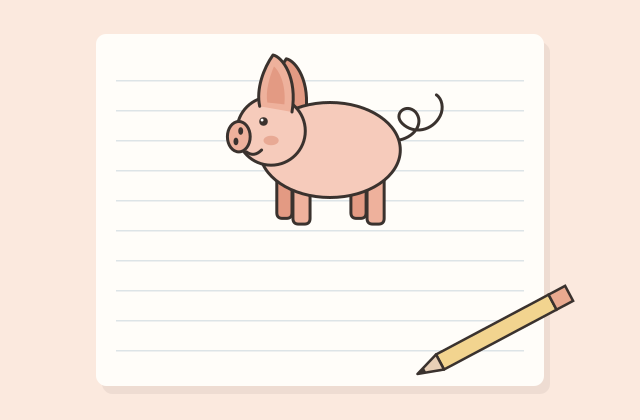
Doing it with a group? Hand out paper, set a one-minute timer and say only, “Draw a pig.” Read the meanings out loud at the end. It works at dinner parties, family holidays and team days.
What does your pig drawing mean?
Here is the classic reading, part by part. It comes from the version most often shared in schools and youth groups.
- Near the top of the page.You’re positive and hopeful.
- In the middle.You’re a realist.
- Near the bottom.You lean toward the gloomy side.
- Facing left.You value tradition, you’re friendly, and you remember dates.
- Facing right.You’re creative and active, but you may forget dates and family isn’t always top of your list.
- Facing you.You’re direct, you like playing devil’s advocate, and you don’t avoid tough talks.
- Lots of detail.You’re analytical, careful and slow to trust.
- Few details.You go with your feelings, see the big picture and take risks.
- All four legs.You feel secure and stick to your beliefs. Some would say stubborn.
- Fewer than four legs.You may be going through a big change and feeling unsure.
- Big ears.You’re a good listener. The bigger the ears, the better.
- A long tail.You’re smart. The longer the tail, the smarter.
About that tail: the person who wrote the most-shared version said he took out the racier descriptions. Other versions, like one handed out at Oxnard College, say a bigger tail means a better love life. You can pick whichever meaning you like better.
Where did the draw a pig test come from?
Nobody knows for sure. The game was shared around the web for years, usually with no name attached.
The version most people see today traces back to a 2011 post on a teaching blog called Teaching Them. It was shared as an icebreaker. In the comments, the blog’s author said he had found the pig test on the web in many places years earlier, and that he edited it to remove the racier parts. The same post says plainly that it’s just for fun and has no scientific value.
From there it spread into classrooms and youth groups. For example, a 4-H teen leadership lesson from Ohio State and Purdue Extension uses the pig drawing as a way to start a talk about personality and teamwork, and it credits that 2011 blog post as its source.
Is the draw a pig test real psychology?
No. It’s a game. But it borrows an idea that psychologists have studied: that drawings might show something about the person who made them.
Some psychologists have used drawing tasks, like asking a person to draw a human figure, as part of their work. In a big review in 2000, psychologists Scott Lilienfeld, James Wood and Howard Garb looked at the research on these kinds of tests. They found the evidence for figure drawings was even weaker than for inkblot tests. If formal drawing tests struggle to hold up, a one-minute pig doesn’t stand a chance.
So why does the reading feel so right sometimes? One reason is the Barnum effect: we tend to see ourselves in general, friendly descriptions. “You’re a realist” or “you remember birthdays” fits a lot of people. That’s part of the fun.
If a line about change or feeling unsure hits a little too close, it’s worth taking seriously, just not because of the pig. Talking it over with a friend can help. So can Iris, a judgment-free thought partner you can text any time.
More picture tests to try
Sometimes it helps to say the messy, unfiltered version out loud to someone who won’t judge it. That’s Iris — text her like you’d text a close friend, and she’ll help you untangle it. She remembers the thread, so next time you can pick up right where you left off.
Frequently asked questions
What does it mean if you draw a pig facing left?
In the classic draw a pig test, a pig facing left means you value tradition, you’re friendly, and you’re good at remembering dates like birthdays. A pig facing right means you’re creative and active but may forget dates. A pig facing you means you’re direct and don’t shy away from hard talks.
What does the tail mean in the draw a pig test?
In the most-shared family-friendly version, a longer tail means you’re smarter. Cheekier versions say a bigger tail means a better love life. Either way, it’s a joke, not a measurement.
What does it mean if my pig has fewer than four legs?
The classic reading says fewer than four legs means you may be going through a big change and feeling a little unsure. Four legs means you feel secure and stick to your beliefs. In real life, it might just mean you ran out of time.
Is the draw a pig test accurate?
No. It’s a party game with no known inventor and no research behind it. Even the version shared by teachers says it’s just for fun. Enjoy it as an icebreaker, and don’t make any big decisions based on your pig.
Who created the draw a pig test?
Nobody knows. It was shared around the web for years before a 2011 teaching blog post made one version popular. That blog’s author said he found it in many places on the web and toned it down.
How long should you take to draw the pig?
Most versions say about a minute, and some groups allow a few minutes. The key is not to overthink it, and not to read the meanings before you draw.
Sources
- Draw the Pig Personality Test (Icebreaker) — Teaching Them, 2011
- What’s Your Personality? (Teen Leadership 20, Pig Analysis handout) — Ohio State University Extension / Purdue Extension 4-H
- Lilienfeld, Wood & Garb, The Scientific Status of Projective Techniques — Psychological Science in the Public Interest, 2000
- The Pig Personality Test (handout) — Oxnard College
- Barnum effect — Wikipedia